• Villa No. 1522, Road 2733 Block 327, Adliya, Bahrain
Blog Details

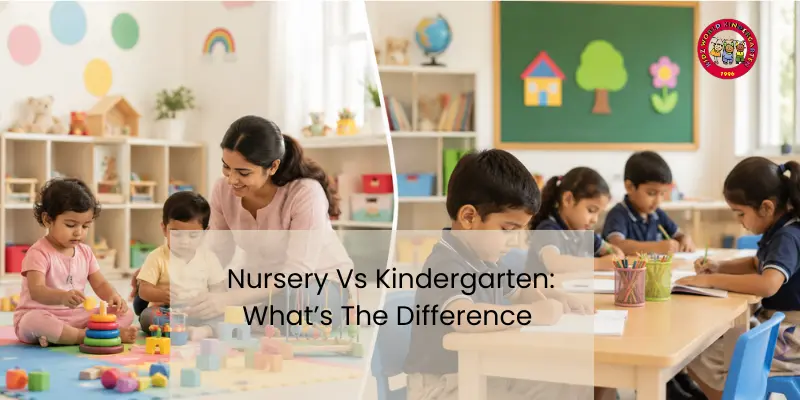
Nursery Vs Kindergarten: What’s The Difference 

Parents may find themselves in conversations, where terms like “nursery”, “preschool” and “kindergarten” are used interchangeably. It can be confusing; are they all the same or do they represent different stages of early childhood education? In fact, even though they are commonly used interchangeably, the terms do have different meanings when applied to early childhood education. Therefore, it is important for parents to understand these differences before deciding which educational institution to enrol their children into.

At Kidsworld Kindergarten, one of Bahrain’s most trusted early education centres since 1996, the journey is carefully structured: Nursery (ages 3–4), Reception (ages 4–5), and Year 1 (ages 5–6). This process ensures that there is proper transition for children from play-based learning to formal learning within the nurturing framework of the British Curriculum. 

Understanding Early Childhood Education

Early childhood education refers to the systematic training and developmental process that takes place with kids until about the age of six, also referred to as the foundation stage, due to its influence on thinking, feeling and behavior of children.

  • What Early Childhood Education Means – Play, discovery and organized learning process.
  • First Five Years Matter – The brain develops up to 90% till the age of five, affecting language, memory and emotions of the child.
  • Structured Learning Through Play – Building blocks, arts and music develop the analytical abilities of the child.
  • Holistic Growth – Both nursery school and kindergarten provide for emotional, intellectual, social and physical growth of the kid.

This blend of play and organization at Kidsworld Kindergarten in Bahrain helps children grow academically, while also developing confidence, friendship and emotional resilience.

What Is A Nursery?

Nursery is the first educational phase that is aimed at children between the age of 3-4. The areas emphasized are play, socialization and independence instead of academics.

  • Learning Through Play – Painting, singing, imaginative play.
  • Building Routines – Snack time, circle time, rest time.
  • Communicating Skills – Expressing oneself.
  • Socializing – Sharing, cooperating, making friends.
  • Developing Motor Skills – Fine (painting) and gross (running, climbing).
  • Developing Independence – Hand-washing, cleaning up toys, self-feeding.
  • Comfort In New Surroundings – Being comfortable without parents.

If you are looking for the best nursery in Bahrain for your child, contact Kidsworld Kindergarten now.

What Is A Kindergarten?

Kindergarten is the level of early childhood education meant for children within the age of 4–6, at which time learning through play starts blending with academic lessons to help prepare them for formal education.

  • Age Group – Children within the age range of 4 to 6 years.
  • Structured Learning – Lessons taught in an organized way with goals set out.
  • Literacy – Recognising letters and sounds and reading.
  • Numeracy – Counting, shape/pattern recognition and basic mathematics like addition/subtraction.
  • Critical Thinking – Puzzles and reasoning. 
  • Classroom Readiness – Learning to abide by rules, concentrate and stay still longer and pay attention to activities.
  • Teamwork – Group assignments and games, learning to work together.
  • Building Confidence – Presenting stories and views in front of others.
  • Preparing For The Primary Level – Making children prepared academically and socially for further studies.

Kidsworld Kindergarten Bahrain conducts this level in such a way to ensure children gain necessary confidence and academic skills to work systematically in the classroom.

Nursery Vs Kindergarten: Key Differences

Although both phases are important, nursery and kindergarten are different in many ways.

Aspect NurseryKindergarten
Typical Age3-4 Years4-6 Years
Learning StylePlay BasedStructured With Play
Daily ActivitiesSongs, Art, Free PlayReading, Writing, Math
Educational GoalsSocialise, IndependentAcademic Readiness
Teacher GuidanceGentle, NurturingStructured, Instructional
Classroom StructureFlexible RoutinesDefined Schedules
Skill DevelopmentCommunication, Motor SkillsLiteracy, Numeracy
Transition FocusComfort In Group SettingsPrimary School Preparation

Skills Children Develop In Nursery

Nursery provides the foundation skills needed to go into kindergarten.

  • Language Development – Vocabulary using songs and storytelling.
  • Social Skills – Learning to share, empathy and cooperating.
  • Emotional Regulation – Controlling emotions.
  • Independence – Dressing, eating and cleaning.
  • Creativity – Arts, music and creative play.
  • Sensory Exploration – Sensory activities using sand and water.
  • Problem-Solving Skills – Puzzles and games.
  • Listening Skills – Listening to instructions and directions.

These skills acquired at this stage make the child confident and socially aware enough to cope with the formal kindergarten setting. Without such skills, learning can become stressful and inefficient.

Skills Children Develop In Kindergarten

Kindergarten provides children with basic academic and social skills.

  • Reading Readiness – Letter recognition.
  • Writing Readiness – Letter writing.
  • Basic Mathematics – Counting, shapes, addition/subtraction.
  • Logical Thinking – Order and reasoning.
  • Communication – Expressing thoughts clearly.
  • Collaboration – Teamwork and Group Projects.
  • Concentration – Focusing for longer periods of time.
  • Responsibility – Taking care of possessions.
  • Confidence – Speaking in front of peers.

These skills help the children to learn how to adjust to classroom settings, adhere to routines and participate in academic and social activities.

How To Know If Your Child Is Ready For Nursery

Nursery readiness is evident when children start to explore and socialize.

  • Curiosity.
  • Likes playing with other kids.
  • Can be away from parents for some time.
  • Can understand instructions.
  • Shows interest in new surroundings.
  • Is able to express his/her needs.

How To Know If Your Child Is Ready For Kindergarten

Readiness for kindergarten is characterized by independence and interest in structured learning.

  • Group participation.
  • Routine following.
  • Curiosity towards reading.
  • Interest in alphabets or numbers.
  • Communication skills.
  • Independent in simple tasks.

How Nursery Prepares Children For Kindergarten

Nursery is very important for children in preparation for kindergarten class. The importance of nursery arises due to its emphasis on early years development.

  • Smooth Transition – Children have an easy transition to classroom expectations.
  • Building Confidence – Independence and confidence help them to be comfortable in a new environment.
  • Familiar With Classroom Routines – The daily routines such as circle time and playtime with groups help them to get used to the kindergarten routines.
  • Communication Skills – Communicating their needs and ideas makes them ready for structured discussions.
  • Increased Attention Span – Short and structured activities help them concentrate in longer activities in future.
  • Friendship Formation – Social relations make them cooperate with other children.
  • Emotional Readiness – Managing emotions helps them to cope up with a more formal environment.

These skills ensure that children enter kindergarten not only academically curious but also emotionally and socially prepared. While a nursery is responsible for laying the foundation, it is kindergarten that builds on the foundation, creating a seamless journey in early childhood education.

Choosing The Right Early Learning Programme In Bahrain

Choosing the appropriate programme helps children develop self-confidence, social skills and academic readiness. Parents need to consider the following.

  • Professional Teachers – Qualified in early childhood development.
  • Safe Learning Environment – Facilities that provide safety as well as friendly classrooms.
  • Child-Centred Curriculum – Designed around developmental needs.
  • Age-Appropriate Learning – Learning activities designed for different age groups.
  • Parent Communication – Effective communication with parents.
  • Small Classroom Size – individualized approach to each child.
  • Play-Based Learning – Learning through creative and problem-solving activities.
  • Facilities Of The School – Well-equipped classrooms and safe outdoor areas.
  • Curriculum –  Many institutions implement British EYFS combining academic and holistic approaches.

By weighing the above-mentioned factors, parents can choose an environment that nurtures children’s emotional, social and academic development in balanced ways.

Why Parents Choose Kidsworld Kindergarten In Bahrain

Parents always want an educational program which helps their children prepare academically as well as emotionally and socially. Our kindergarten in Bahrain offers several strengths that make it a trusted choice.

  • British EYFS Curriculum – Internationally renowned educational system.
  • Experienced Staff – Highly qualified and experienced teachers.
  • Safe And Nurturing Environment – Safe premises and dedicated staff.
  • Play-Based Learning – Creativity and problem-solving through fun activities.
  • Well-Equipped Classrooms – Modern and equipped classrooms for young children.
  • Indoor And Outdoor Activities – Balance between exploration and play.
  • Holistic Child Development – Comprehensive development of children emotionally, socially and academically.
  • Parent-School Collaboration – Active communication and participation.
  • Smooth Transition From Nursery To Kindergarten – Step by step progress making kids more confident.

Kidsworld Kindergarten welcomes parents to discover our programmes or come for a visit to experience firsthand how we foster each child’s growth through a safe, nurturing, and academically balanced environment.

Comments are closed